Car Cost Calculator
Compare petrol, electric and hybrid cars on the cost that actually matters: what the car can cost you to run each year after energy, insurance, vehicle tax and routine servicing.
What does the car really cost each year?
A cheap purchase price does not automatically make a cheap car. Insurance, fuel or charging, Vehicle Excise Duty and servicing can change the picture. Enter the figures for the car you are considering, or use the typical values provided as a starting point.
Compare one car at a time
The calculator uses current UK reference prices and lets you change the assumptions to match the exact vehicle.
The calculator will show which cost areas deserve attention.
| Annual cost | Estimate | Comment |
|---|
Insurance benchmarks across the UK
There is no single UK insurance price for a car. The latest Confused.com Price Index is based on more than six million real quotes and shows substantial regional differences. These figures are useful for comparing the effect of location, not for predicting an individual's quote.
| Region | Average comprehensive premium |
|---|---|
| South West England | £504 |
| West of England | £564 |
| South of England | £580 |
| North of England | £606 |
| South East | £620 |
| North East | £624 |
| East | £627 |
| North West | £663 |
| Midlands - North | £666 |
| South Central England | £686 |
| Midlands - East | £709 |
| Leeds / Sheffield | £798 |
| Manchester / Merseyside | £807 |
| Midlands - West | £860 |
| London - Outer | £899 |
| London - Inner | £1,088 |
| Central & North Wales | £511 |
| South Wales | £570 |
| Scottish Borders | £539 |
| Central Scotland | £717 |
| East & North East Scotland | £599 |
| Highlands & Islands | £583 |
| Northern Ireland | £1,020 |
Source: Confused.com Price Index, Q2 2026 data. Premiums are averages of new comprehensive policies and are not personalised quotes. Age also makes a major difference: the same dataset reports approximately £1,813 for ages 17–20, £1,255 for 20–29, £850 for 30–39, £699 for 40–49, £552 for 50–59, £459 for 60–69 and £482 for 70+.
Petrol, electric or hybrid?
The cheapest choice depends on how you drive and how you charge or fuel the car. A comparison should include more than the sticker price.
Petrol
Simple refuelling and a very broad used and new-car choice. Current petrol prices make fuel consumption particularly important. Smaller, efficient petrol cars can remain highly competitive where annual mileage is modest.
Electric
Home charging can produce a low cost per mile, while public rapid charging can be considerably more expensive. Servicing can be lower for some EVs, but insurance and purchase price must also be considered.
Hybrid
Full hybrids can be attractive for mixed urban and motorway driving because they recover energy during braking and do not require charging. Plug-in hybrids need realistic assumptions about how often they are charged.
Petrol servicing
Which? reports an average of £335 for petrol cars aged 0–4 years and £305 for 5–9 years in its servicing-cost dataset.
Electric servicing
Which? reports £351 for electric cars aged 0–4 years and £283 for 5–9 years. EVs do not automatically mean zero maintenance.
Hybrid servicing
Which? reports £332 for full hybrids aged 0–4 years and £369 for 5–9 years. Plug-in hybrids were higher at £444 and £445 respectively.
These are average servicing figures from Which? survey data, not guaranteed annual bills for an individual vehicle.
Road tax: the rules that can change the calculation
Electric cars are no longer exempt from Vehicle Excise Duty. From 1 April 2026, the standard rate for many cars registered from 1 April 2017 is £200 after the first year. New vehicles have a CO₂-based first-year rate, and an additional expensive-car supplement can apply.
Petrol
Post-April-2017 cars generally move to the £200 standard rate after the first year, but the first-year VED depends on CO₂ emissions. Older cars follow different rules.
Electric
Cars registered from 1 April 2025 pay £10 for the first year and then the £200 standard rate. Electric cars over the applicable expensive-car threshold can also face the supplement.
Hybrid
Hybrids are treated as alternative-fuel vehicles for these tables but do not receive the former VED discount. Their tax depends on registration date and emissions rules.
Compare the whole market before you buy
No single insurer or comparison website is guaranteed to return the cheapest quote for every driver. Use several sources, check the policy wording and compare like-for-like cover.
One important warning about “cheapest car” lists
There is no honest single list of every car sold in Britain ranked from cheapest to most expensive to own. The exact result changes with model, trim, engine or battery, purchase price, depreciation, age, driver, postcode, annual mileage, insurance history, tariff and charging access. This tool therefore separates real published benchmarks from your own vehicle assumptions.
Which Car Should You Choose?
A practical UK recommendation for choosing between petrol, hybrid and electric — with brands and models worth putting on your shortlist, plus direct insurance quote links so you can check the real price before you buy.
Our recommendation in one minute
There is no single best car for everybody. For most buyers, the right choice depends on annual mileage, access to home charging, how much motorway driving you do, insurance cost and how long you intend to keep the car.
Full hybrid
For a buyer who wants low fuel use without depending on charging, a good full hybrid is currently the safest all-round recommendation.
- Excellent for mixed urban and normal driving
- No home charger required
- Automatic driving
- Strong range and easy refuelling
- Good choice for keeping the car several years
Electric
Choose electric when you can charge cheaply at home or work and your normal journeys fit the car's range.
- Very low energy cost with economical home charging
- Very little routine mechanical servicing
- Quiet and easy to drive
- Increasing choice and strong manufacturer incentives
- Public rapid charging can change the economics
Petrol
Petrol remains attractive for lower annual mileage, buyers who cannot charge at home and people wanting the widest choice of used cars.
- Simple refuelling network
- Broad choice at many prices
- Can be economical at modest mileage
- No charging planning
- Fuel cost is the main disadvantage
Our recommended brands and models
These are not claims that every model from a brand is perfect. They are sensible starting points based on current UK availability, pricing, powertrain choice, practicality and the reliability information available. Always check the exact trim and insurance group.
Toyota
Look first at: Yaris, Yaris Cross and Corolla.
Toyota has a very broad self-charging hybrid range and strong UK availability. The Yaris is currently listed from £23,995 and the Yaris Cross from £27,445 on Toyota UK.
Toyota UK — view & configureHonda
Look first at: Jazz e:HEV and HR-V e:HEV.
Honda's current UK range includes self-charging hybrids and the company allows customers to configure and buy online. The Jazz starts from £28,475 and HR-V from £32,725.
Honda UK — configure & buyRenault
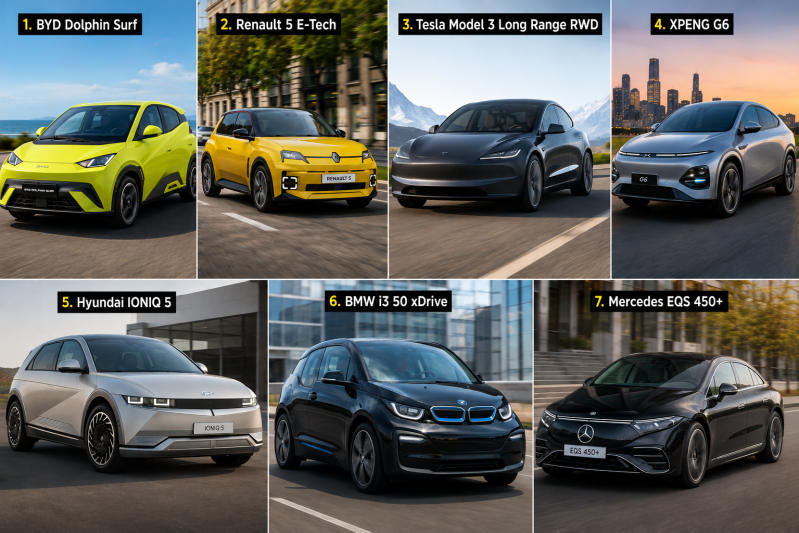
Look first at: Renault 5 E-Tech Electric.
The Renault 5 starts from £21,495 including the Electric Car Grant on Renault UK's current configurator. It is one of the strongest choices for an affordable small EV.
Renault 5 — configureŠkoda
Look first at: Elroq.
The Elroq is a practical electric SUV with up to 372 miles WLTP range in the current UK specification and starts from £33,970 in the SE L 60 specification.
Škoda UK — ElroqFord
Look first at: Puma Gen-E.
The Puma Gen-E is currently offered with a £3,750 Electric Car Grant, with Ford listing a recommended on-the-road price of £26,245 after the grant.
Ford UK — Puma Gen-EKia
Look first at: Sportage Hybrid and Kia's electric range.
Kia remains one of the UK's strongest mainstream brands for practical family cars, with hybrid, plug-in hybrid and electric options. Compare the exact insurance quote before deciding.
Kia UK — explore carsWhat we would choose by situation
| Your situation | Our choice | Why | Models to investigate |
|---|---|---|---|
| Mostly town / city | Full hybrid or small EV | Both can be efficient in stop-start driving. EV wins if home charging is cheap and convenient. | Toyota Yaris, Honda Jazz, Renault 5 |
| Mixed driving, no home charger | Full hybrid | You keep the convenience of petrol refuelling while gaining electric assistance around town. | Toyota Yaris/Yaris Cross, Honda Jazz/HR-V |
| Home charger + regular daily commuting | Electric | Home charging can make energy cost substantially lower than petrol on suitable tariffs. | Renault 5, Ford Puma Gen-E, Škoda Elroq |
| Long motorway journeys | Efficient hybrid or long-range EV | Choose according to charging access. A hybrid avoids charging stops; a good long-range EV can work very well with reliable rapid charging. | Toyota Corolla, Honda CR-V, Škoda Elroq |
| Lowest purchase budget | Petrol or affordable EV | Do not assume EV is expensive: grants and manufacturer discounts can change the entry price. | Renault 5, efficient small petrol cars |
| Want one car for many years | Full hybrid or EV | Prioritise reliability evidence, warranty, servicing network and the exact insurance cost rather than badge alone. | Toyota, Honda, Škoda, Renault |
Our view on petrol vs hybrid vs electric
Choose petrol when...
You drive relatively few miles, cannot charge at home, regularly make unpredictable long journeys, or find that the equivalent hybrid/EV costs too much more to buy or insure.
Choose hybrid when...
You want the easiest compromise. It is particularly attractive for mixed urban and rural driving when you do not want to think about charging.
Choose electric when...
You can normally charge at home or work, your daily mileage is predictable, and the insurance quote and purchase price still make sense.
Where should you get your car insurance?
Our recommendation is not to choose an insurer before you have obtained several real quotes. The same car can produce dramatically different premiums for different drivers and postcodes. Use the links below to obtain actual prices and compare the cover, excess and extras on a like-for-like basis.
Admiral
Good first quote to check, particularly if you want comprehensive cover, multi-car options or electric/hybrid insurance. Admiral says its quote considers the car, driver, location, mileage and other factors.
Get an Admiral quoteLV=
Worth checking as a direct insurer. LV= provides online car quotations and has a 5-star Defaqto-rated car insurance product.
Get an LV= quoteDirect Line
Another direct insurer worth quoting rather than assuming it will be cheaper or more expensive. Get the exact price for your vehicle and circumstances.
Get a Direct Line quoteChurchill
Churchill offers direct online car insurance quotations. Compare the policy benefits as well as the headline premium.
Get a Churchill quoteRAC
RAC offers online car insurance and says its panel is used to find competitive quotes. Its online product is designed for self-service management.
Get an RAC quoteComparison shopping
Do not rely only on direct insurers. Use a comparison service to see a wider panel, then compare the final cover and price carefully.
Compare car insuranceDo not forget the hidden cost of the car
Insurance group
UK cars are placed into insurance groups from 1 to 50. The group is useful for comparing cars, but it is not the same thing as your actual premium.
Vehicle tax
From April 2026, many post-2017 cars have a £200 standard VED rate. Electric cars are no longer exempt, and expensive-car supplements can apply.
Servicing
Do not assume an EV has zero maintenance or that a hybrid is automatically cheap. Check the exact manufacturer's service schedule and local servicing prices.
Depreciation
This can be one of the largest costs of owning a newer car. A car that is cheap to fuel can still be expensive overall if it loses value quickly.
Charging access
For an EV, home charging can transform the economics. If you rely heavily on public rapid charging, calculate using the prices you will actually pay.
Tyres and repairs
Large wheels, performance tyres and heavier vehicles can cost more. Check tyre size and replacement prices before choosing the trim.
Our final shortlist
If we were narrowing down a sensible UK shortlist today, we would start here — then obtain an insurance quote for every exact model before making the final decision.
| Category | First car to investigate | Second choice | Why |
|---|---|---|---|
| Small hybrid | Toyota Yaris Hybrid | Honda Jazz e:HEV | Efficient, automatic, easy to live with and no charger required. |
| Family hybrid | Toyota Corolla | Kia Sportage Hybrid | Strong mainstream choices for mixed use and family practicality. |
| Small EV | Renault 5 E-Tech | Ford Puma Gen-E | Strong current pricing and access to the UK EV grant on eligible versions. |
| Family EV | Škoda Elroq | Ford Puma Gen-E | Practicality, range options and mainstream support. |
| Petrol | Efficient small petrol car | Used petrol from a reliable mainstream brand | Best considered where mileage is modest or charging is impractical. |
CARS & TRANSPORT
Choose a car based on the whole cost — not just the badge.
A car can be one of the largest purchases a household makes.
The price displayed in a showroom or advertisement is only part of the calculation.
ELECTRIC CARS
Electric vehicles can offer advantages in certain circumstances, but suitability depends on factors such as:
-
Purchase price
-
Charging access
-
Electricity costs
-
Insurance
-
Mileage
-
Vehicle range
-
Battery considerations
-
Maintenance
-
Depreciation
There is no single electric car that is best for everyone.
USED CARS
A lower purchase price does not necessarily mean a cheaper car.
Consider:
-
Vehicle history
-
Mileage
-
Condition
-
Service history
-
Insurance
-
Fuel or electricity costs
-
Maintenance
-
Expected depreciation
VALUE FOR MONEY
When comparing cars, ask:
What will this car cost me over three or five years?
The answer can be very different from the purchase price.
Our car guides focus on the overall ownership picture rather than simply recommending the newest or most expensive vehicle.
This table contains the clickable photo links alongside each model. PDF. Downloadable.